Landing Page Builder

Create a Real Estate Landing Page

Go from idea to a professionally designed, conversion-optimized real estate landing page — powered by AI

No credit card required · 14-day free trial

Examples

Real estate pages built with one prompt

Diverse real estate landing pages created with Swipe Genie to demonstrate the range of what's possible

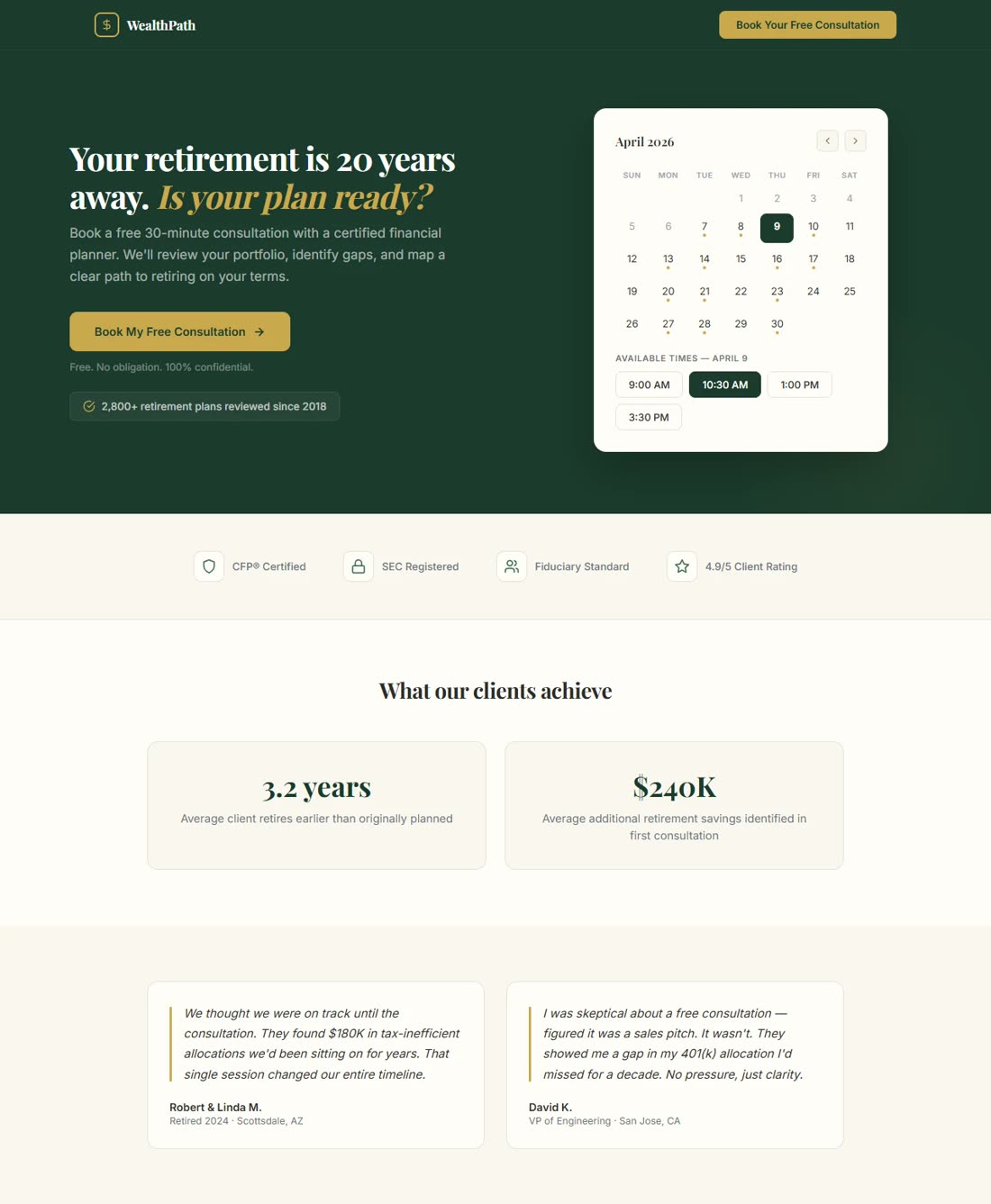
Buyer Lead Capture

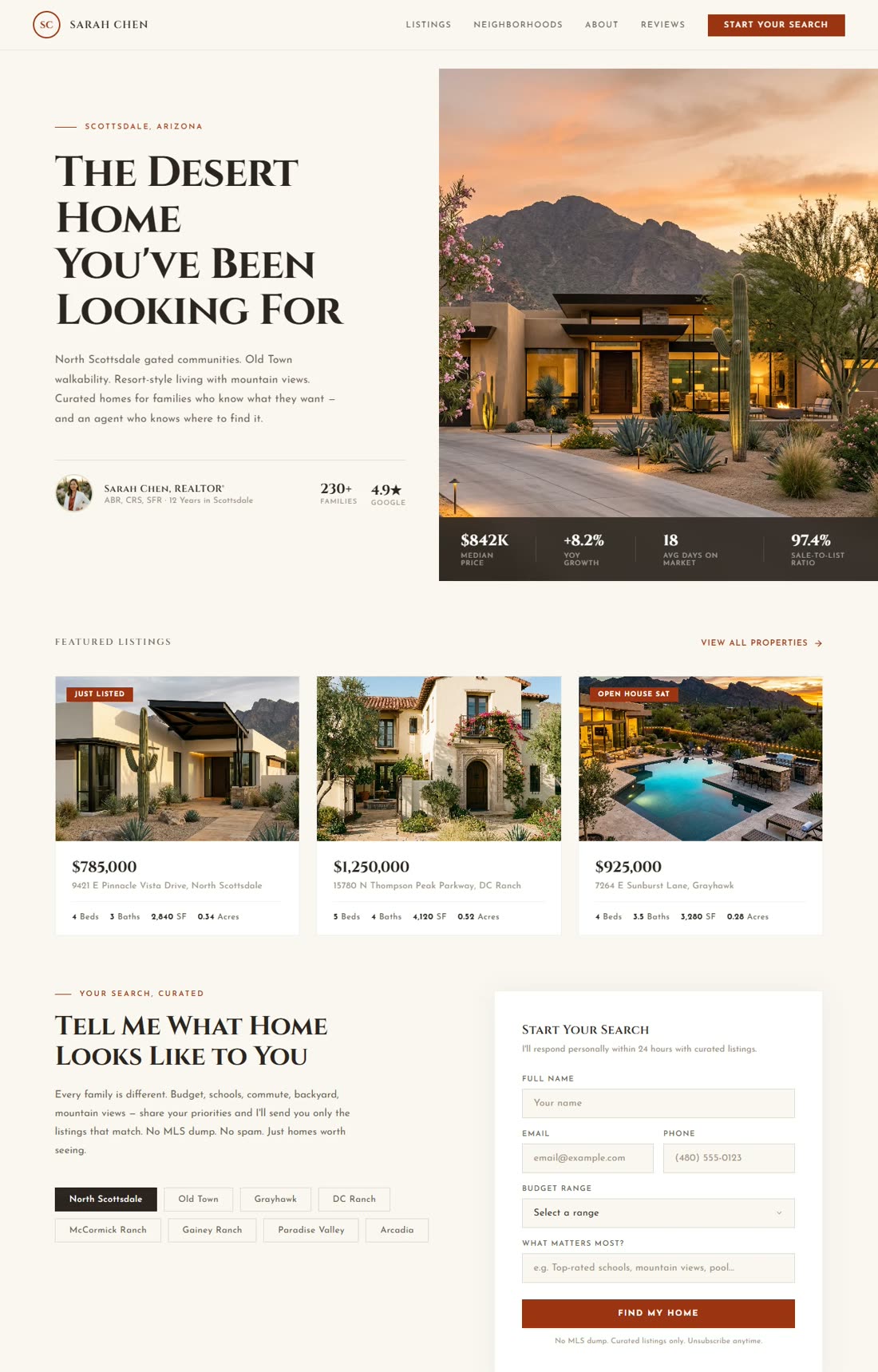
"Create a real estate landing page for Sarah Chen, a Realtor in Scottsdale, AZ specializing in family homes. Clean, approachable design with warm desert tones — sandstone, sage green, and white. Include a home search lead form (name, email, phone, budget range, neighborhood preference), featured listings section with 3 property cards, neighborhood guide highlights, agent bio with headshot, and client testimonials."

Scottsdale Realtor

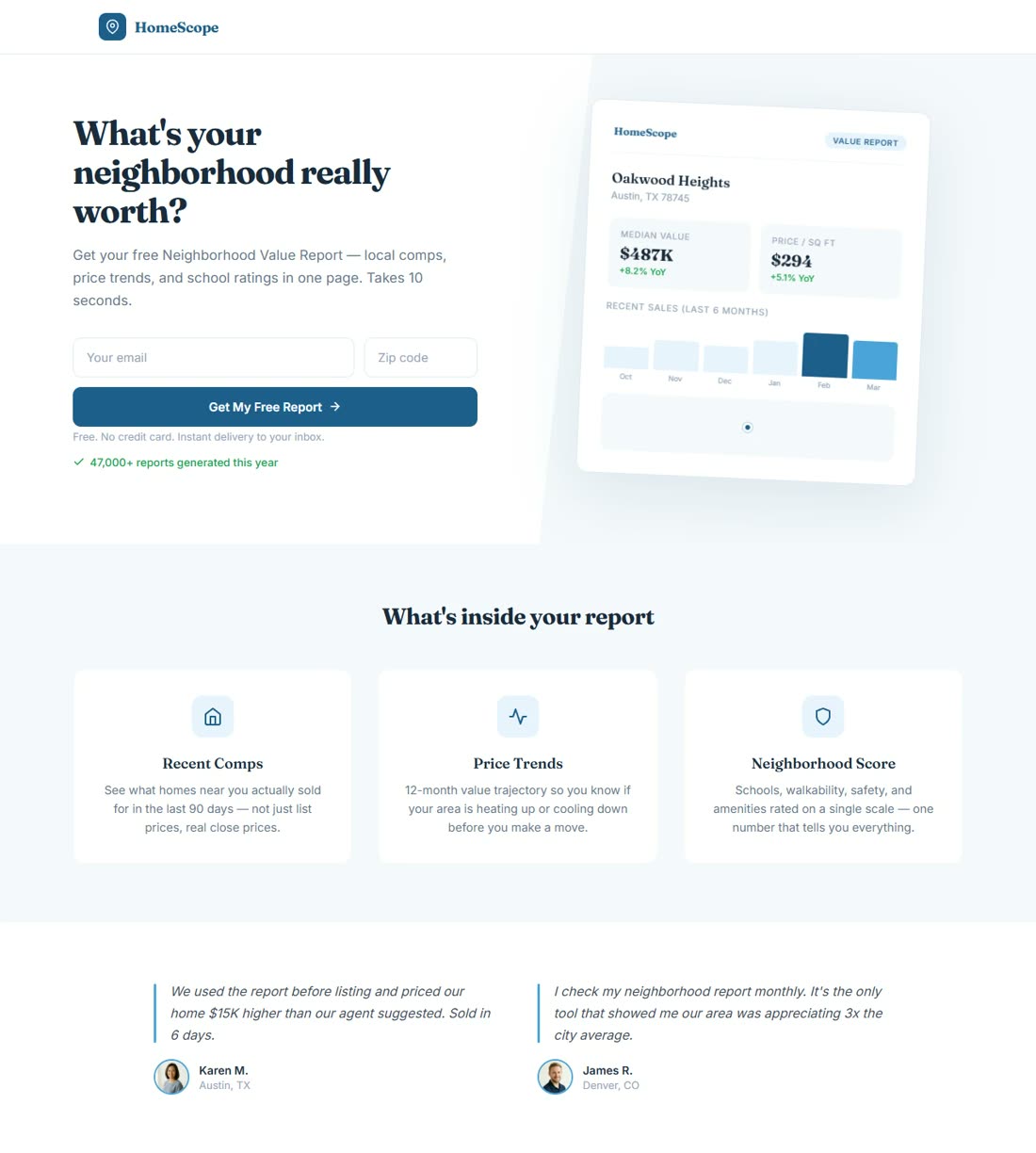
Seller Lead / Home Valuation

"Build a luxury real estate landing page for The Whitmore Group, a high-end brokerage in Manhattan. Elegant black and gold design with large property photography. Hero should feature a penthouse with city views. Include a 'What's Your Home Worth?' CTA with a simple form (address, email, phone), recent sold properties with prices, press mentions (WSJ, NYT), and a team section with agent photos."

Manhattan Luxury Brokerage

New Development Pre-Sale

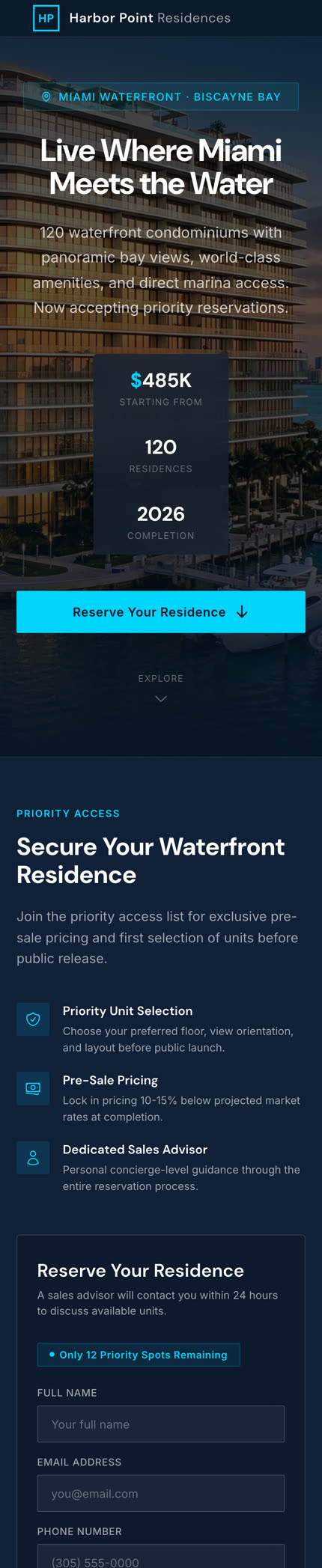
"Create a pre-sale landing page for 'The Residences at Harbor Point,' a waterfront condo development in Miami. Modern, architectural design with navy and white. Include a hero with a rendering of the building, floor plan previews, amenity highlights (pool, gym, concierge), a pricing-from section, a registration form for priority access (name, email, phone, unit preference), and a Google Maps embed showing the location."

Harbor Point Development

Lead Magnet Download

"Design a lead gen page for HomeStart Realty offering a free 'First-Time Homebuyer Toolkit' PDF. Friendly, supportive design with soft blue and warm white. Include a book mockup of the toolkit, three bullet points about what's inside (buying timeline, mortgage checklist, negotiation scripts), a simple form (name, email), agent bio, and a section about the local market with 2-3 stats."

First-Time Buyer Guide

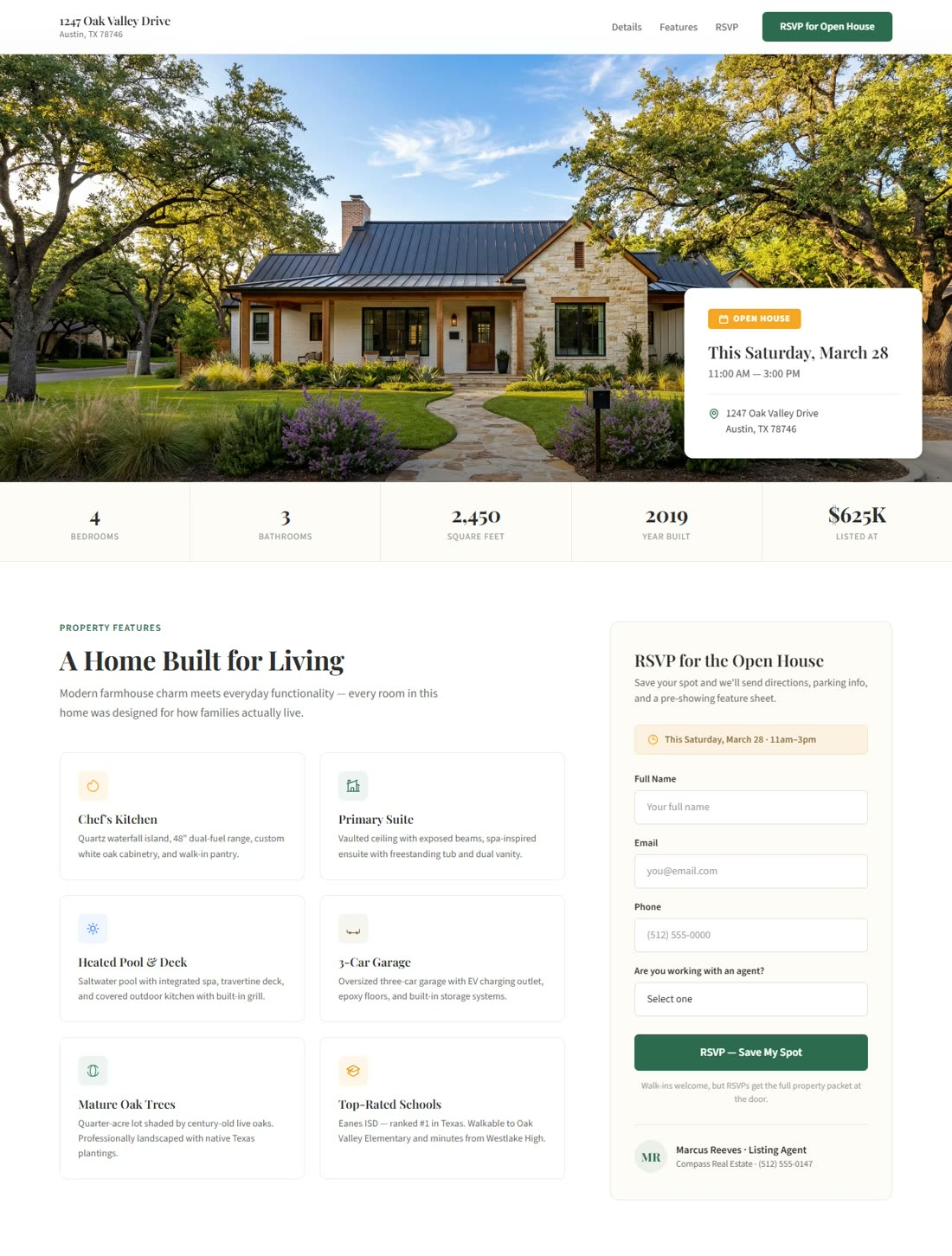
Open House / Single Listing

"Build a landing page promoting an open house for a 4-bed/3-bath home at 1247 Oak Valley Drive, Austin TX. Bright, inviting design with a large hero photo of the home exterior. Include open house date/time, photo gallery (6-8 images), key property details (square footage, lot size, year built, school district), Google Maps location, and an RSVP form (name, email, phone). Agent contact info at the bottom."

Austin Open House

Commercial Lease Inquiry

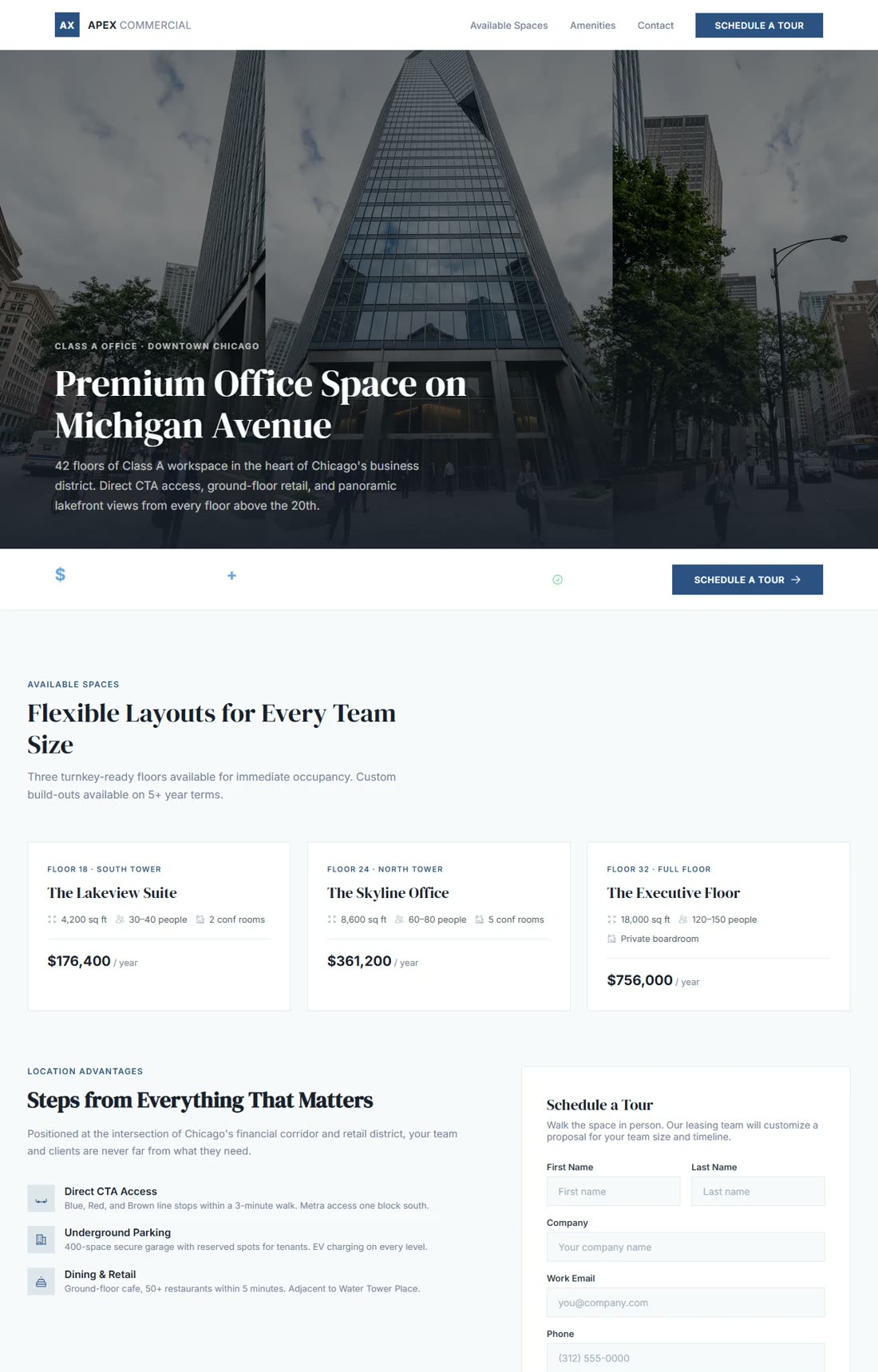
"Create a landing page for Apex Commercial Real Estate showcasing Class A office space for lease in downtown Chicago. Professional, corporate design with steel blue and charcoal tones. Include building exterior and interior photos, floor plan options, key specs (square footage, lease terms, parking), tenant amenities, location advantages (transit access, nearby dining), and a contact form for scheduling a tour."

Chicago Office Space

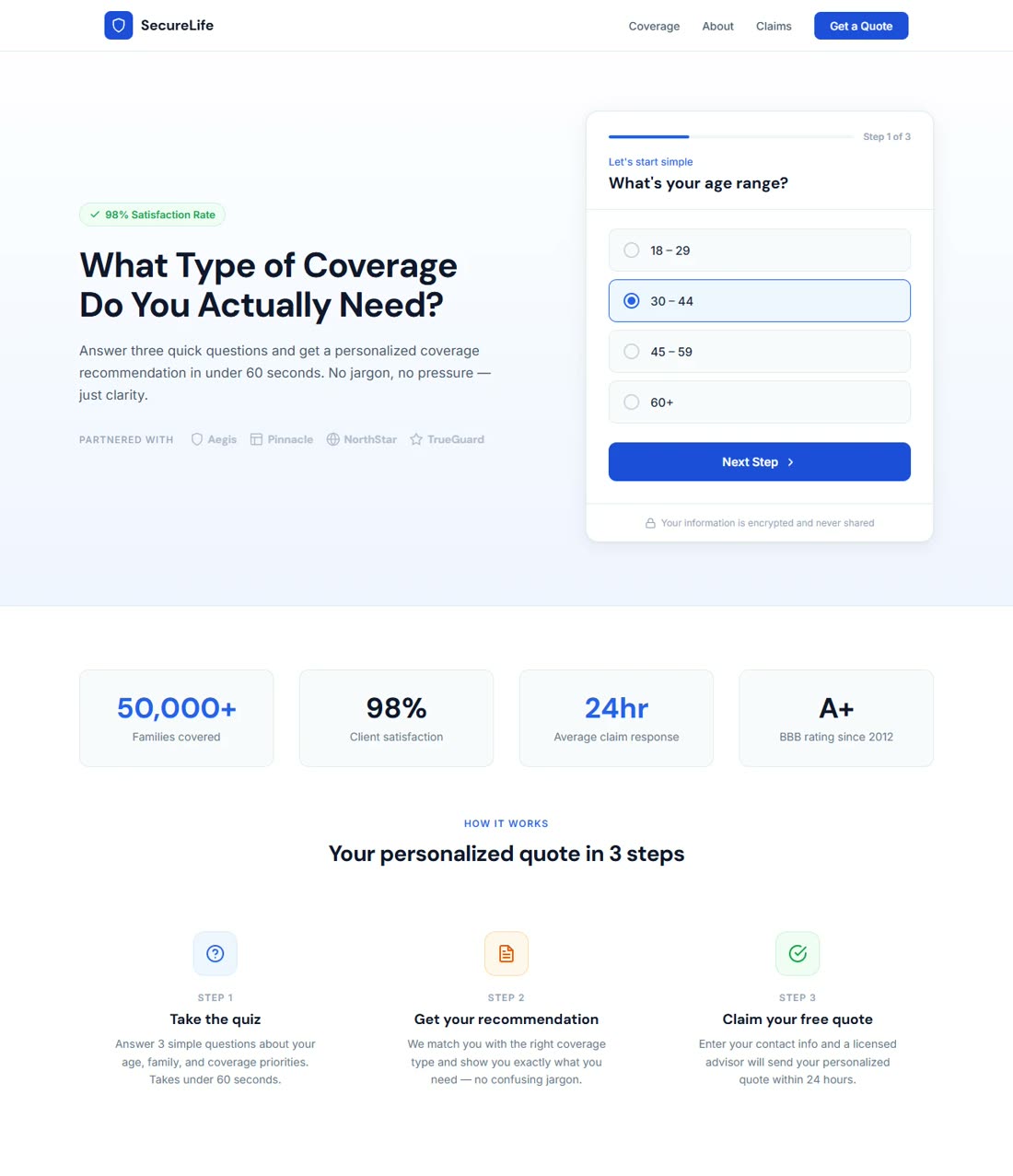
Service Lead Gen

"Design a lead capture page for GreenKey Property Management targeting landlords in the Denver metro. Clean, trustworthy design with green and white. Hero headline: 'Stop Managing Your Rental. Start Profiting From It.' Include a management fee calculator, services breakdown (tenant screening, maintenance, rent collection), 3 landlord testimonials with rental income stats, and a form for a free property evaluation."

Property Management Denver

Build Your Real Estate Landing Page

No Credit Card Required | Try for Free

How It Works

How to create a real estate landing page

01

Describe Your Business, Goals & Objectives

Share your real estate niche, market, and the type of leads you're after. Paste your brokerage website, MLS links, or existing marketing materials.

02

Match Your Brand Style

Pick a design preset or let the AI match your brokerage branding — luxury, approachable, modern, whatever fits your market.

03

Watch Swipe Pages AI Create Your Real Estate Landing Page

The AI builds your complete page — property imagery, lead capture form, agent bio, testimonials, CTA — structured to maximize lead submissions.

04

Edit & Publish

Refine by chatting with the AI. Swap photos, adjust form fields, add a virtual tour. Publish — live on a global CDN in seconds.

Worth reading before you build

Why real estate professionals need landing pages

important!

Real estate is a relationship business, but the relationship starts online. 96% of homebuyers search online during their home purchase, and 74% use mobile devices as part of that search. The agent or brokerage that captures attention in that digital window gets the lead. Everyone else is chasing referrals and hoping for walk-ins.

Most agents send their ad traffic to an IDX website — a property search portal that looks like every other agent's site. The visitor searches a few listings, maybe bookmarks one, and leaves without ever identifying themselves. The agent paid for the click and got nothing in return. An IDX site is a browsing tool. A landing page is a lead capture tool. They serve fundamentally different purposes.

The economics are stark. Google Ads in real estate run $3.50-$5.50 per click in most markets, with major metros pushing well above that. The average cost per lead via paid search is $50-$150 depending on the market and lead type. Buyer leads are cheaper ($9-20 per lead through optimized campaigns), while seller leads — the higher-value prospects — cost $26-60 or more. In competitive markets like New York, San Francisco, or Miami, CPLs of $200-350 are common. At these prices, every percentage point of conversion rate improvement directly impacts your bottom line.

Dedicated landing pages consistently outperform generic real estate websites for paid campaigns. A well-structured page with a clear offer — "Get your free home valuation," "See homes in [neighborhood] before they hit MLS," or "Download our first-time buyer guide" — converts paid traffic at 3-5% versus the 0.5-1% typical of general real estate websites. That's a 3-5x improvement that compounds across every dollar of ad spend.

Video is the most underused weapon in real estate marketing. Listings with video generate 403% more inquiries than those without, and agents using video marketing grow revenue 49% faster than non-video agents. A landing page gives you the space to embed property walkthrough videos, neighborhood tours, and agent introduction clips — none of which fit into a standard IDX listing format.

The local nature of real estate makes landing pages especially powerful. Every market, neighborhood, and property type represents a different audience with different concerns. A luxury condo buyer in Miami cares about amenities and investment returns. A first-time buyer in Austin cares about mortgage programs and school districts. A landlord in Denver cares about property management fees and vacancy rates. One page can't speak to all three. But three landing pages — each tailored to a specific audience, keyword, and offer — can capture all three audiences with conversion-optimized messaging. This is how top-producing agents and teams scale their lead generation without scaling their ad budgets proportionally. See how luxury real estate developers use focused landing pages in the Swipe Pages inspiration gallery.

Features

Everything real estate professionals need. Nothing they don't.

Create a SaaS comparison page for Acme

Every Real Estate Page — One Prompt Away

Buyer lead capture, seller home valuation, open house pages, new development pre-sales, neighborhood guides, agent bio pages — describe what you need and the AI builds it aligned to your brokerage brand.

Audit Complete

Idea: Change CTA text to "Start Free Trial" to lift conversions by ~12%.

Apply
Dismiss

CRO AI Agent

After launch, the CRO agent monitors lead conversion rates and suggests improvements — better headline angles, form positioning, social proof placement. Continuous optimization without a marketing consultant.

What's your goal?
Generate Leads
Sell Products

Smart Forms & Lead Qualification

Property preference quizzes, multi-step forms (property type → budget → contact info), and home valuation request forms — all built in. Multi-step flows reduce friction and capture higher-quality leads.

99

Blazing Fast

Sub-second load times globally. Agents paying $3.50-5.50 per click can't afford a slow page. Fast pages keep visitors engaged and lower cost per click over time.

Mobile-First Design

74% of real estate searches happen on mobile. Smart Pages deliver a swipe-based experience with persistent CTAs. Click-to-call buttons for prospects who want to reach you immediately.

Winner
14.2%
Variant A
vs
8.5%
Variant B

A/B Testing & Built-In Analytics

Test different property photos, headlines, form lengths, and lead offers. Server-side split testing with built-in analytics. GA4, GTM, and Meta CAPI for full attribution from ad click to lead.

SP

CRM & Follow-Up Integrations

Leads flow directly to Follow Up Boss, HubSpot, Salesforce, or any CRM through native integrations and Zapier. Automatic follow-up triggers the moment a lead submits — critical when speed-to-lead determines who gets the client.

English → Spanish

One-Click Translation

Serving international buyers? Translate any page into their language instantly. Especially valuable for luxury markets and cities with diverse buyer demographics.

Startup
$29
Marketer
$69
/mo

Pricing That Makes Sense

Plans start at $29/mo — roughly the cost of a single Google Ads click in competitive markets. No traffic penalties, everything included. 14-day free trial, no credit card.

Social Proof

Trusted by 7,000+ teams worldwide

4.8
★★★★★
G2
4.9
★★★★★
Capterra
300+ reviews
Results
★★★★★

Swipepages got me to 60-100% CR. Been using for over a year now... I've used ClickFunnels and GoHighLevel - and I've never had such high conversion rates.

Jordon S.

TrustPilot

Speed
★★★★★

The pages are stable and fast, helping increase my conversion rates when the user lands from my ads or other sources.

Victor R.

Sales & Partners Channels Manager · G2

PPC
★★★★★

Running google ads with swipe pages as a landing page builder increase conversions.

Sergio C.

Boss · Capterra

Ease of Use
★★★★★

It is incredibly easy to use. The best part about that is when you are training new employees, you can just quickly show them how to make changes without a lot of involved training.

Andi L.

Digital Marketing Manager · Capterra

A/B Testing
★★★★★

Multivariate or A/B tests can be created with the click of a button, and the analytics to determine winners/losers are clear and simple to understand.

David P.

Marketing Consultant · G2

Versatile
★★★★★

I typically have clients who struggle with using WordPress. Swipe Pages has allowed me to create not just limited to product landing pages; we sometimes use them as invitation pages and form pages for market surveys.

Douglas S.

Draftsperson · G2

Mobile
★★★★★

The best thing I like about Swipe Pages is their Smart pages option, which means that mobile traffic will only be directed to a landing page where you can swipe sections of your page instead of scrolling.

Edwin J.

Founder · G2

Integrations
★★★★★

Swipepages is incredibly easy to use and has powerful integrations with the tools we use most.

Kamonasish Aayush M.

Co-Founder & CEO · Capterra

Value
★★★★★

Cost effective landing pages for any size company. Many of our clients were worried about paying $150 to $299 for CF. After we shift to SP, many of our clients were able to afford.

Verified User

G2 Review

FAQ

Frequently asked questions

Because your IDX website is built for browsing, not converting. An agent's website serves multiple purposes — property search, bio page, blog, contact page, active listings. That's useful for organic visitors who discovered you through Google and want to poke around. But for paid traffic — Google Ads, Facebook campaigns, Instagram promotions — a multi-purpose site bleeds conversions.

Here's the scenario that plays out thousands of times a day. An agent runs a Google Ad targeting "homes for sale in [city]." A buyer clicks, lands on the agent's homepage or IDX search page, browses three listings, and closes the tab. The agent paid $4-5 for that click and captured zero information. No name, no email, no phone number. The buyer is gone, and the agent has no way to follow up.

A dedicated landing page changes the equation entirely. Instead of dumping the visitor into an open search, the page presents a focused offer: "See 15 off-market listings in [neighborhood] — enter your email for instant access." Or "Get your free home valuation — find out what your property is worth in today's market." The visitor engages with a specific value proposition, fills out a short form, and becomes a lead you can nurture.

The conversion difference is substantial. General real estate websites convert paid traffic at 0.5-1%. Dedicated landing pages with clear offers convert the same traffic at 3-5%. For an agent spending $2,000/month on ads, that's the difference between 10 leads and 50-100 leads from the same budget.

Beyond paid campaigns, real estate landing pages serve as anchors for content marketing. Your neighborhood guide blog post links to a landing page for a free buyer's guide. Your Instagram post about a new listing links to a landing page with all the photos and a showing request form. Your email newsletter promoting an open house links to a landing page with event details and RSVP. Each page is a conversion point that turns attention into contact information.
Real estate landing pages follow a specific structure because real estate decisions involve trust, local expertise, and high-dollar commitment. Every element earns confidence.

Headline with local specificity. Generic headlines kill real estate pages. "Find Your Dream Home" could be any agent in any city. "New Listings in North Scottsdale This Week" tells the visitor you know their market. Include the neighborhood, city, or property type in your headline — it signals relevance and expertise immediately.

Hero image. In real estate, the image does most of the selling. Use professional photography of a property, a neighborhood streetscape, or a lifestyle shot that represents your market. Avoid stock photos — they read as generic and undermine the local expertise you're trying to project. For luxury markets, full-bleed photography with minimal text overlay works well. For first-time buyer markets, a warm, inviting image paired with approachable copy builds trust.

Lead capture form. Keep it short for top-of-funnel offers — name and email for a buyer guide, or email and address for a home valuation. For higher-intent pages (showing requests, consultation bookings), add phone number and a qualifying question like budget range or timeline. Multi-step forms that start with property preferences before asking for contact info convert well because the visitor is invested before they see the form.

Agent credibility section. Real estate is personal. Include your headshot, credentials, production stats, years in the market, and a brief bio that emphasizes local knowledge. Buyers and sellers want to work with someone who knows the neighborhood, not just someone with a license.

Social proof. Client testimonials with specific outcomes carry enormous weight. "Sarah helped us find a home $30K under budget in a competitive market" beats "Great agent, highly recommend." Include the number of transactions, average days on market, or percentage of asking price achieved. Zillow or Google review ratings add third-party credibility.

Property showcase or market data. For buyer-focused pages, show 3-5 featured listings or neighborhood stats (median price, days on market, year-over-year trends). For seller-focused pages, show recent sold properties with sale prices to demonstrate market activity and your track record.

Clear, singular CTA. "See Available Homes" for buyer pages. "Get Your Free Home Valuation" for seller pages. "Schedule a Showing" for listing pages. One action per page. The CTA should appear at minimum twice — once in the hero and once at the bottom.
Build pages per audience, not per agent. The biggest mistake agents make is creating one landing page for everything. Buyers need different messaging than sellers. First-time buyers need different information than luxury buyers. Investors care about different metrics than primary residence seekers. Build separate pages for each audience and traffic source — the conversion lift more than justifies the effort.

Lead with local knowledge. Mention specific neighborhoods, streets, school districts, and local landmarks. Reference current market conditions ("In Q1 2026, Scottsdale median home prices rose 8% year-over-year"). This level of specificity signals to the visitor that you're not a generic agent — you're the local expert. It also naturally incorporates long-tail keywords that help with SEO.

Use property-quality photography. Real estate is visual. Every image on your landing page should be professional-grade. This doesn't mean hiring a photographer for the landing page itself — it means using professional listing photos, high-quality neighborhood shots, and a polished headshot. Blurry, poorly-lit images signal that you cut corners, which is the last impression you want a potential client to have.

Embed video where possible. Video is the most underutilized asset in real estate marketing. A 60-second agent introduction video on a landing page builds trust faster than any written bio. A property walkthrough video keeps visitors engaged longer. The data supports this — listings with video generate 403% more inquiries, and video on landing pages boosts conversions by up to 86%.

Optimize for mobile aggressively. 74% of homebuyers use their phones during the search process. Your landing page must load fast (under 2 seconds), display properly on all screen sizes, and make the form easy to complete with thumbs. Click-to-call buttons are essential for real estate — many prospects prefer to call directly rather than fill out a form, especially for high-ticket properties.

Follow up within minutes. Speed-to-lead is everything in real estate. Connect your landing page to a CRM that triggers an immediate automated response — text, email, or both — the moment a form is submitted. Research shows that responding to a lead within 5 minutes makes you 21x more likely to qualify that lead versus waiting 30 minutes.

Run A/B tests on your hero image and headline. These two elements have the highest impact on conversion rates. Test different property photos, different market angles ("Move-In Ready Homes" vs. "New Listings This Week"), and different lead offers ("Free Home Valuation" vs. "See Off-Market Listings") to find what resonates with your specific market.
Primary KPI: Lead conversion rate. The percentage of landing page visitors who submit a form. For real estate, benchmarks vary by traffic source. Paid search (Google Ads) should target 3-5%. Social media ads (Facebook, Instagram) typically convert at 1-3%. Organic traffic varies widely but strong pages hit 5-8%. If you're below these ranges, the page needs work.

Cost per lead (CPL). Calculate by dividing your total ad spend by the number of leads captured. Industry benchmarks: buyer leads cost $9-20 per lead on well-optimized campaigns, seller leads run $26-60+. In major metros, expect $100-350 per lead. Track CPL by campaign, ad group, and keyword to identify your most efficient traffic sources.

Lead-to-appointment rate. What percentage of form submissions become actual consultations or showings? This measures both lead quality and follow-up effectiveness. A healthy benchmark is 20-30% of leads converting to appointments. Below 10% suggests either poor lead quality (traffic mismatch) or slow follow-up.

Time-to-response. Track how quickly you or your team contacts new leads. Under 5 minutes is ideal. Under 15 minutes is acceptable. Over an hour and you've likely lost the lead to another agent who responded faster.

What to A/B test: 1. Hero image — Test property exterior vs. interior vs. neighborhood shot vs. lifestyle image. The visual sets the emotional tone for the entire page. 2. Lead offer — "Free Home Valuation" vs. "See Off-Market Listings" vs. "Download Neighborhood Guide" — test which offer generates the most and best-quality leads. 3. Form length — Test 2-field (name, email) vs. 4-field (name, email, phone, budget). Shorter forms generate more leads; longer forms may generate more qualified leads. 4. Social proof type — Test client testimonials vs. transaction stats vs. review ratings. Different audiences respond to different credibility signals. 5. CTA copy — "Get My Home Value" vs. "See What Your Home Is Worth" vs. "Request Free Valuation." Small wording changes can shift conversion by 10-20%.

Geographic performance. If you're running campaigns across multiple neighborhoods or zip codes, track conversion rates per area. Some markets will outperform others based on competition, property values, and buyer intent.
Real estate professionals need pages fast — a new listing drops tomorrow, an open house is this weekend, a neighborhood campaign launches Monday. And your audience is overwhelmingly mobile. Swipe Pages handles both with AI.

AI that builds every page type you need. Buyer lead capture, seller home valuation, open house RSVP, new development pre-sale, neighborhood guide, agent bio page — describe what you need and the AI creates a complete, professional page in minutes. New listing tomorrow? Upload photos, describe the property, and have a landing page live before it hits MLS. Open house Saturday? Page with event details, gallery, and RSVP form — done in one conversation.

CRO agent for continuous optimization. Your pages don't just launch and sit. The CRO AI agent monitors conversion rates, identifies where leads drop off, and suggests data-backed improvements. In a market where every lead costs $50-150, even a small conversion lift from continuous optimization pays for the platform many times over.

Mobile-first for a mobile-first audience. 74% of buyers search on their phones. Smart Pages create a swipe-based mobile experience with persistent CTAs and click-to-call buttons that never scroll out of view. This isn't just responsive design — it's a mobile-native experience built for how people actually browse properties.

Sub-second speed that protects your ad spend. Real estate PPC clicks cost $3.50-5.50+ each. A slow page loses a third of those visitors before they see your listing. Every Swipe Pages page loads in under a second from a global CDN — no degradation, no traffic-based pricing.

Smart forms that qualify leads. Multi-step forms that start with property preferences before asking for contact info convert better because the visitor is invested. Quiz-style qualification, budget range dropdowns, timeline selectors — all built in. No separate form tool.

A/B testing to find what your market responds to. Test property photos, lead offers ("Free Home Valuation" vs. "See Off-Market Listings"), form lengths, and CTA copy. Server-side split testing with built-in analytics — no external tools needed.

CRM integrations for instant follow-up. Leads flow directly to Follow Up Boss, HubSpot, Salesforce, or any CRM the moment they submit. Speed-to-lead determines who gets the client — automate your first response in under 5 minutes.

One-click translation for international markets. Serving international buyers? Translate any page instantly. Especially valuable for luxury markets and cities with diverse buyer demographics.

Pricing that works for agents and teams. $29/mo to start — the cost of a single PPC click. No traffic penalties. Agency plan at $149/mo with unlimited sub-accounts for brokerages and teams. 14-day free trial, no credit card required.

Start building your real estate landing page

Go from prompt to published page in minutes. Capture more buyer and seller leads. 14-day free trial, no credit card required.

No credit card required · Instant setup