People plan a trip at midnight and book the operator who made it easy. Swipe Pages puts the gallery, the inclusions and the deposit form on one travel landing page that loads on any connection.
14-day free trial, no credit card required
4.8174 reviews4.9176 reviews
Atoll AzureOVER-WATER · NORTH MALE ATOLL24/7 CONCIERGE
TRAVELERS' CHOICE 2026
A private lagoon. A villa on stilts.
YOUR FIRST THREE DAYS
Day 1Seaplane in. Sunset dhoni cruise.
Day 2House reef by the ladder. Breakfast on the deck.
Day 3In-villa spa. Dinner on the sandbank.
Sunset Villa · 7 nights from $1,850 / night · 2 guests
CHECK AVAILABILITY
Seven nights above the reef.
Arrive
May 14, 2026
Depart
May 21, 2026
Guests
2 adults
Check availability→
Free cancel up to 45 days out · Seaplane included
31%More bookingsBooked from a phone
Atoll Azure source photograph · illustrative itinerary and availability form
Fast mobile load times for photo galleries
A dedicated page for each tour package
Capture travel dates with multi-step forms
The problem
Three obstacles that lower travel booking inquiries
Heavy photo galleries slow down mobile pages
Destination photos sell trips, but heavy image files cause standard pages to load slowly on mobile phones, losing travelers.
One website tries to promote twenty packages
You offer safaris, beach resorts, and cultural tours, but send paid ad clicks to a generic website where visitors get lost.
Inquiries arrive without dates or guest numbers
When forms only ask for an email, your travel agents waste hours exchanging emails just to get travel dates and party sizes.
The answer
A dedicated landing page for every destination, resort, and season
Swipe Pages gives travel operators the speed to launch visual, high-converting package pages and multi-step quote forms in minutes.
Six landing pages travel operators build in Swipe Pages
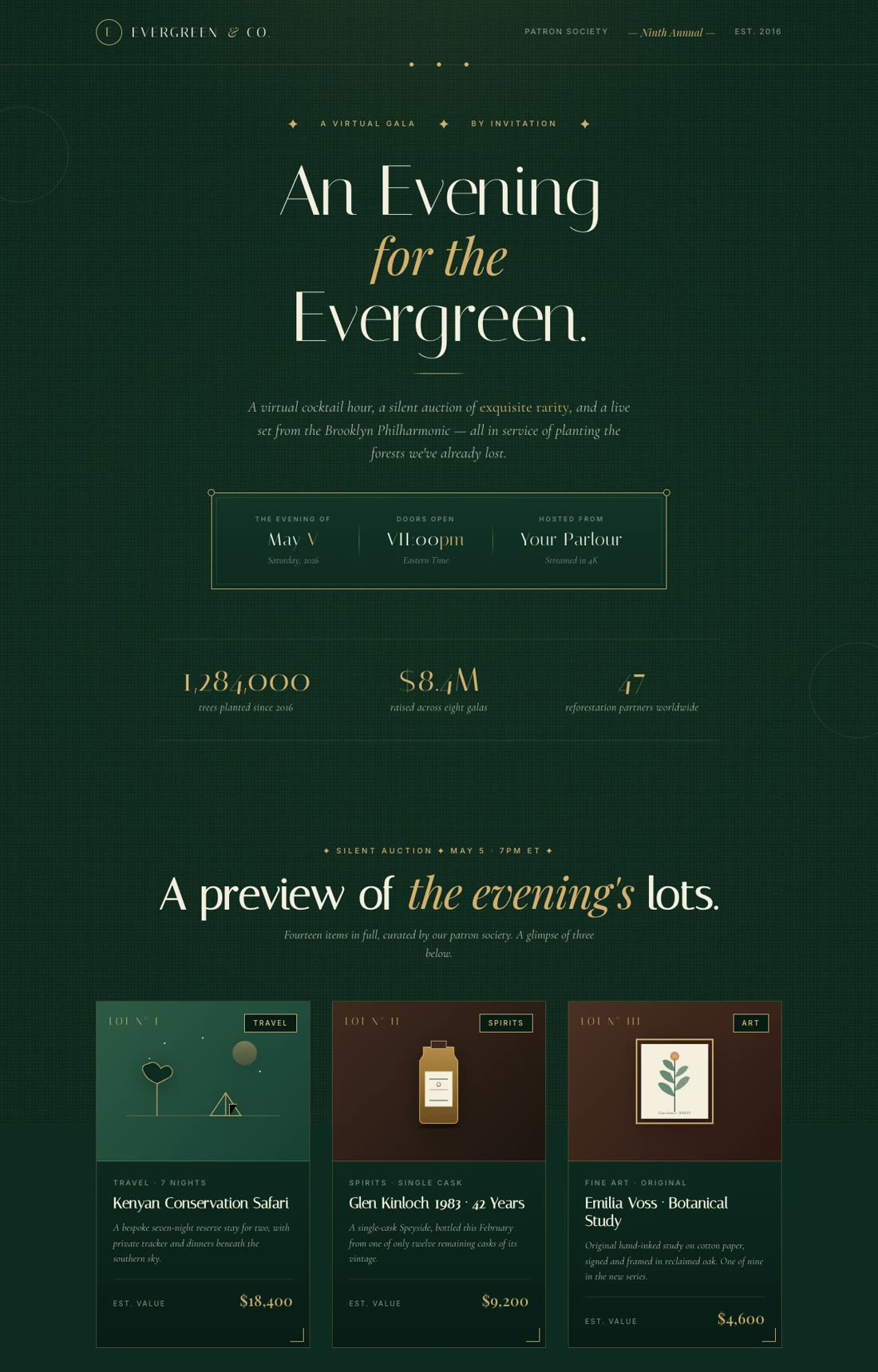
A registration page for our group departure event, with the date, the venue and a form.Recreate with AI
Event registration pageEvergreen is a virtual gala page with the date, the venue and the registration form. A group departure or a travel event uses the same shape.
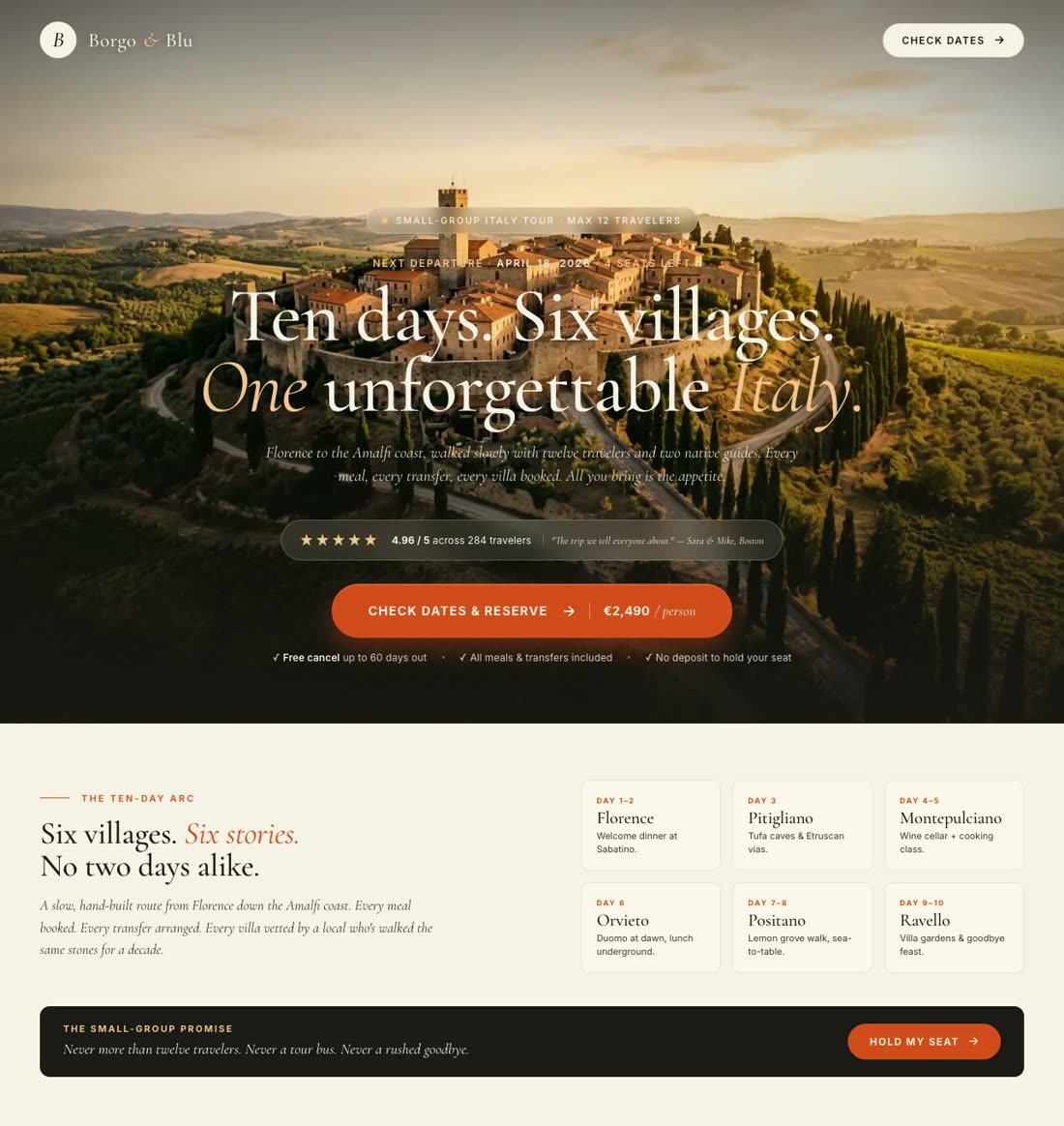
An itinerary page for a seven day Tuscany tour, with the day by day and the price.Recreate with AI
Tour itinerary packageBorgo Blu lays out a Tuscany and Amalfi tour with the days, the places and the price on one page. Travellers compare itineraries, so put yours where it can be read in full.
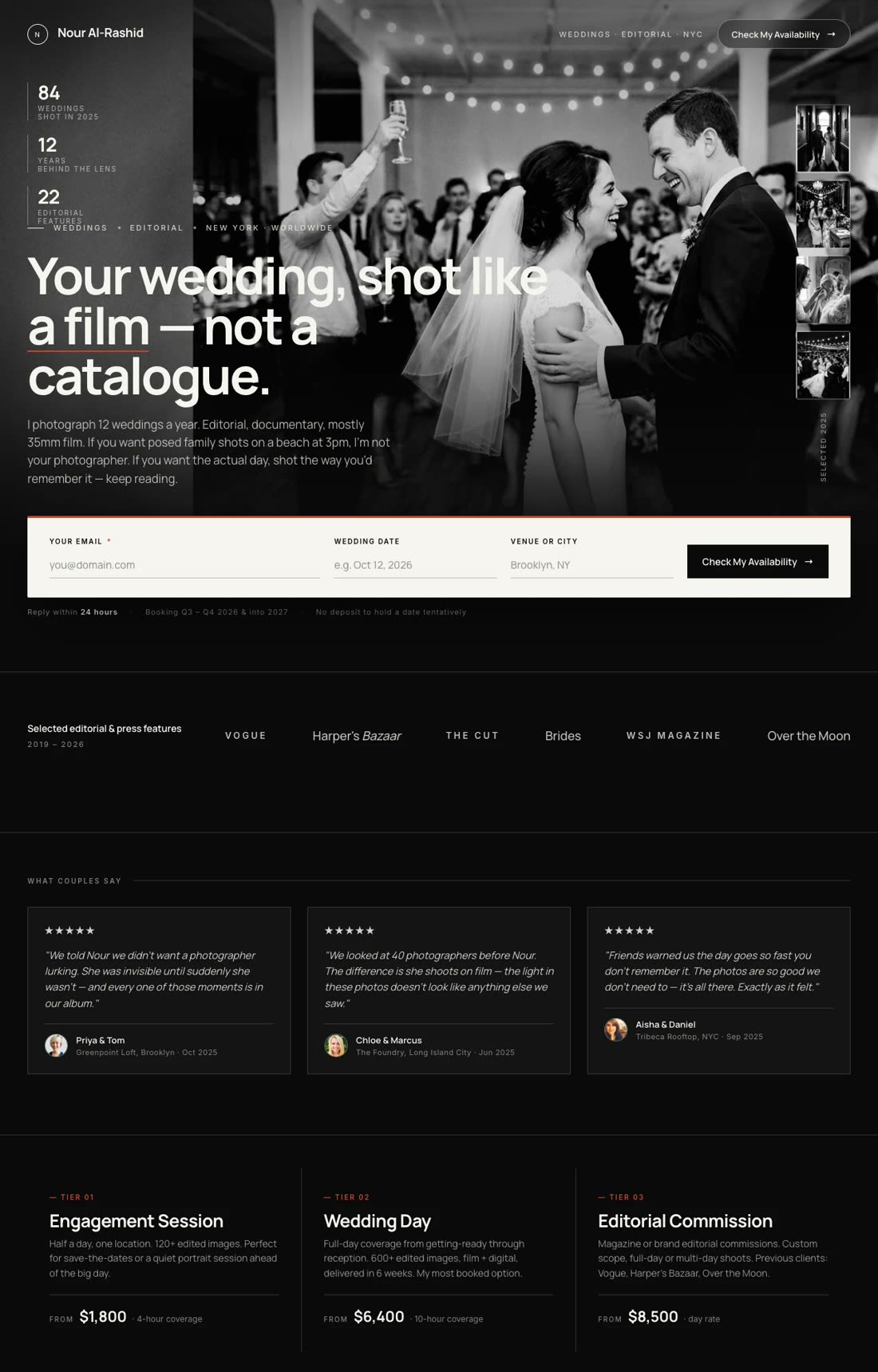
An enquiry page for destination weddings, with a full bleed gallery and a date picker.Recreate with AI
Wedding photographer pageNour is a photographer's page where the gallery carries the decision. A destination wedding operator sells one occasion the same way, with a form that only has to catch it.
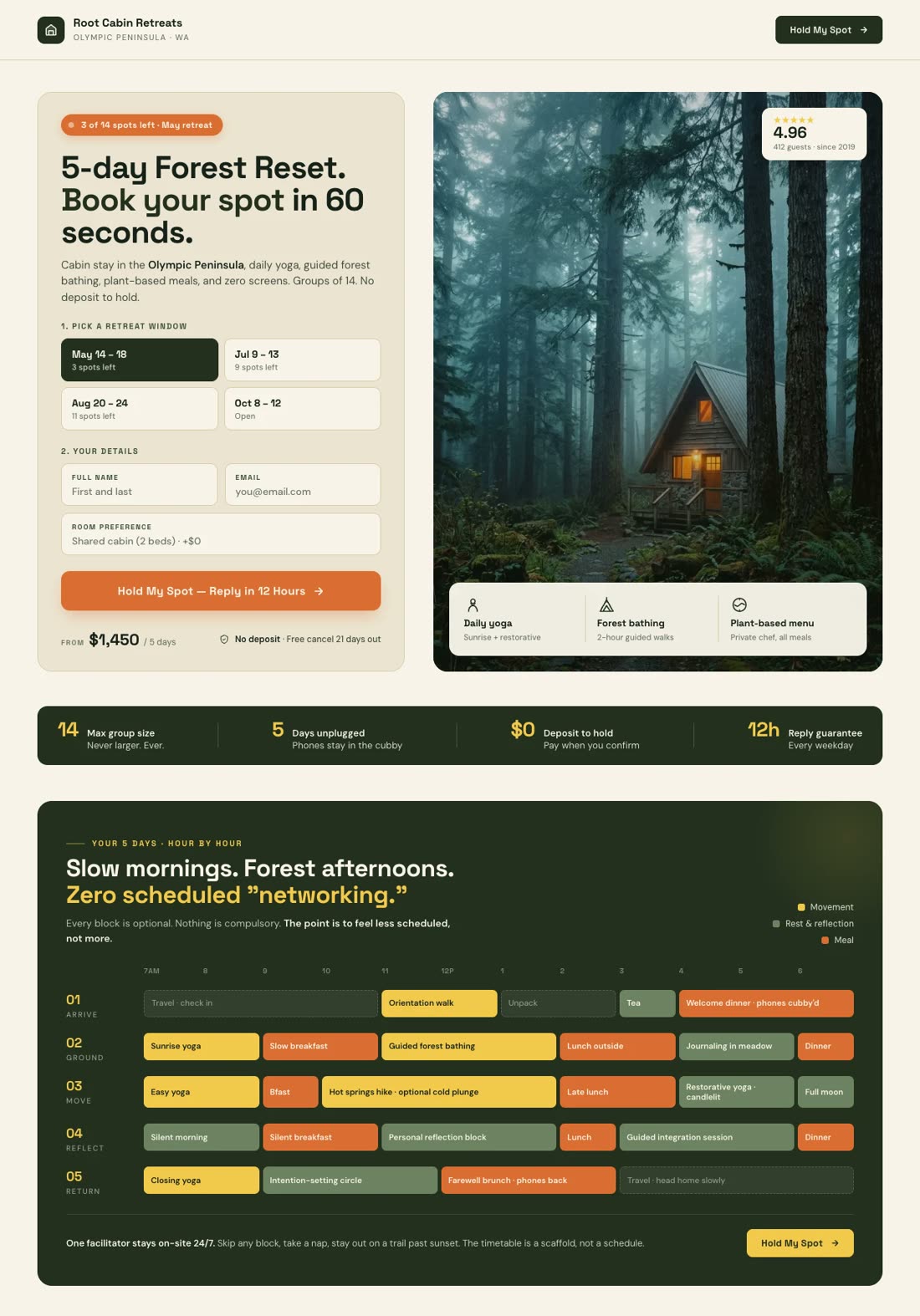
A booking page for a forest wellness retreat, with dates, pricing and a deposit button.Recreate with AI
Forest retreat bookingRoot Cabin takes the deposit on the page with the pricing and the dates in the open. Retreats sell out on clarity, not on atmosphere.
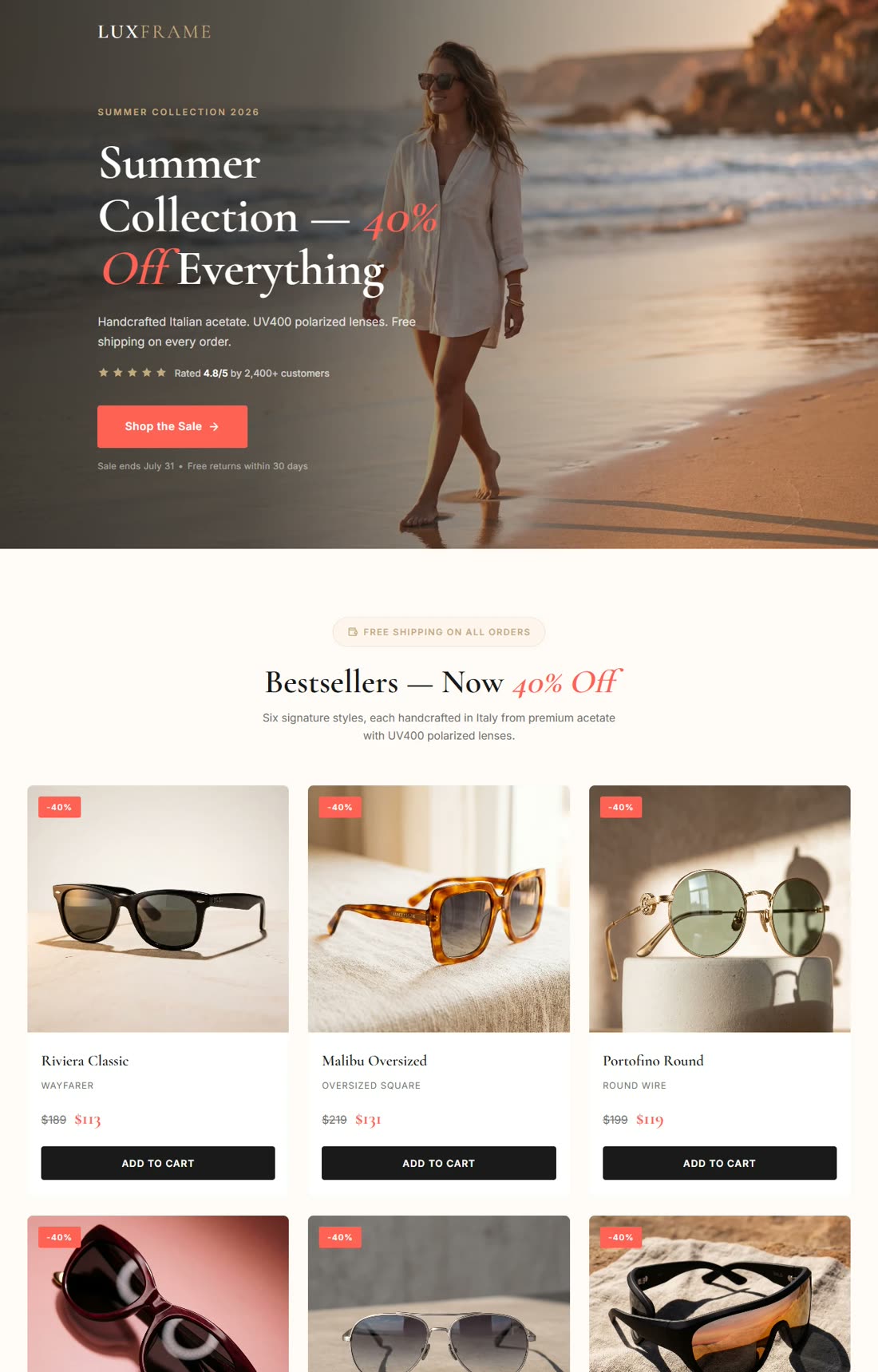
A seasonal offer page with 40 percent off, sunset photography and a countdown.Recreate with AI
Summer sale offerLuxframe is an eyewear summer sale, useful as a reference for a shoulder season or last minute campaign with a real deadline. Change the photography and the dates and the page is new again.
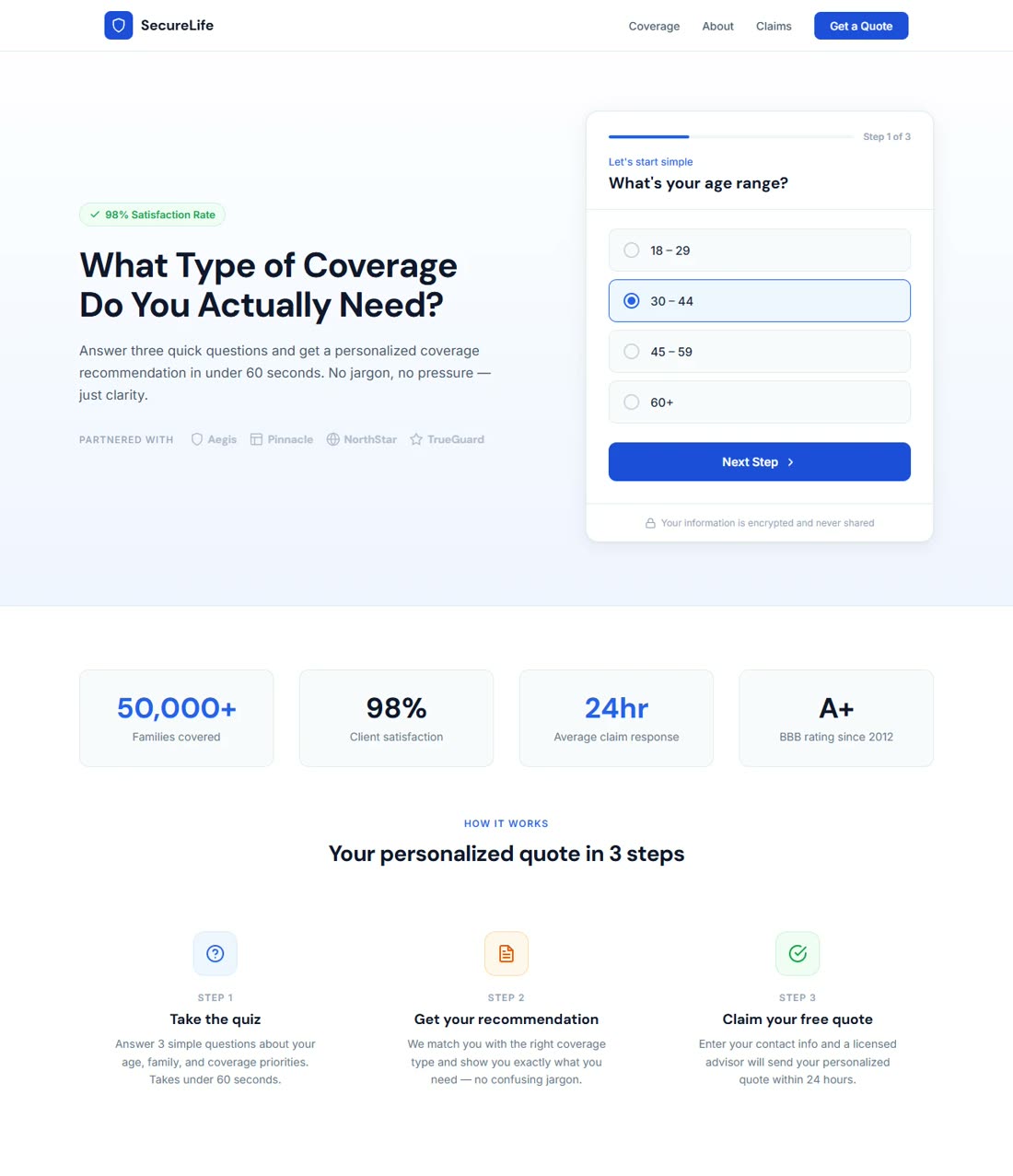
A quiz that asks dates, group size and budget, then recommends two itineraries.Recreate with AI
Quote quizSecureLife is an insurance quiz, a reference for asking dates, party size and budget in steps before showing the two trips that fit. Better than a search box for anyone still deciding.
Countdown Timers
Fill seasonal departures with countdown timers
Add countdown timers for seasonal booking deadlines and early-bird rates to encourage travelers to finalize plans.
Sunda SoulHONEYMOONS · UBUD, BALI
Private · Seven Nights · Ubud
Seven mornings of just the two of you.
A private pool villa above the Ayung river, a couples' massage in the jungle, a chef who learns your names by morning two.
STAYS1 Sep to 30 Nov 2026HONEYMOON REVIEW INDEX4.97 / 5 · 218 couples
Your seven nights include
Private pool villa
Couples' massage
Sunset dhow cruise
Private driver daily
Chef's breakfast daily
Airport VIP transfer
$3,400+FOR TWO ALL-INCLUSIVE
EARLY-BOOKING RATE · BOOK BY 30 JUNE
21DAYS09HRS42MIN18SEC
Reserve with a $500 deposit→
Balance 45 days before arrival · Free to cancel 45 days out
Three nights in Lisbon, Prague or Budapest. Flights from $399, boutique hotel and a locals-led walking tour.
LisbonFROM $3993 NIGHTS
PragueFROM $4493 NIGHTS
BudapestFROM $4293 NIGHTS
See Available Weekends
free cancel up to 14 days out
98Google PageSpeedAMP Technology
Illustrative, Weekend Europe source style
Mobile Speed for Photo Galleries
Load your photo galleries in under a second
Swipe Pages optimizes every landing page with AMP technology and runs 20+ speed tasks every time you publish, then serves it from a CDN in 40+ locations. High-resolution resort galleries and destination photos open instantly on mobile devices without lag.
Multi-Step Travel Quote Forms
Get the dates and the party size before you quote
Capture the traveler's name and email on step one to lock in the lead. Then ask for intended travel dates, party size, and estimated budget on step two. Your agents receive complete trip requirements before preparing a custom itinerary.
RIDGELINEPATAGONIA EXPEDITIONS
STEP 1 OF 2 · W CIRCUIT QUOTE
Start with your details.
Full name
Alex Morgan
Email
alex@example.com
Contact saved
STEP 2 OF 2 · 8 DAYS · MAX 10 TRAVELERS
When, and how many of you?
Travel dates
Nov 04 to Nov 11, 2026
Group size
4 travellers
Fitness level
Weekend walkerRegular hikerMountain fit
Get my quote→
Quote within 24 hours · From $2,100 USD · Free cancel up to 60 days out
Illustrative, Ridgeline source style
Build the page forNiseko early birdfamilies
Style Your brandColour Your brandAI images
Alpine Base Niseko7-NIGHT CHALETS · HOKKAIDO, JAPAN
Early bird · December 2026
Ski Niseko in December. Book by October 31.
$2,890$2,490/ personSave $400
Dec 14 → Dec 21 · 7 nights · Sleeps 6
Reserve your chalet4 CHALETS LEFT
Slopeside chalet7 NIGHTS · SLEEPS 6
Full lift passHANAZONO · HIRAFU
Airport transferCHITOSE · PRIVATE
Daily breakfastJAPANESE + WESTERN
Illustrative, Alpine Base source style
AI Builder for Travel Packages
Build a travel landing page for every destination in minutes
Tell Swipe Pages which package or resort you are promoting. Our AI writes the destination copy, formats daily itinerary accordions and amenity grids, and fetches your photos from your own website to fill the galleries.
Automated Travel Guide Delivery
Deliver destination guides and brochures automatically
Attach your downloadable destination PDF brochure or packing checklist directly inside Swipe Pages. When a traveler submits their email, they can download the guide immediately on the thank-you screen.
Send booking inquiries straight to your travel team
Every trip inquiry goes to HubSpot, Zoho, Mailchimp, ConvertKit, Constant Contact or Campaign Monitor directly, and anywhere else through Zapier. Your booking team receives immediate notifications to respond while travelers are planning.
Conversion APIs
Send trip enquiries back to ad networks
Send completed trip inquiries back to Meta and Google Ads through conversion APIs to help algorithms target travelers planning vacations.
Sunda SoulHONEYMOONS · UBUD, BALI
Your enquiry is in.
Kade will reply within 12 hours with your villa and your dates.
TRAVEL DATES3 to 10 Oct 2026
GUESTS2 · Villa 04
No deposit to request a quote · Free to cancel 45 days out
CONVERSION EVENT1 LeadSent from the confirmation page. No guest details.
Meta AdsReceived
Google AdsReceived
Illustrative, Sunda Soul source style
RESERVE YOUR CHALET4 chalets left
Save $400 per person on December 2027 departures.
CHECK IN → CHECK OUTDec 13 → Dec 20, 2027 · 7 nightsUpdated
TRAVELERS4 adults · 2 bedrooms
$2,990$2,590/ personUpdated
Lock in early bird pricing
Free cancel up to Oct 15 · $1 holds your dates
Clone the 2026 early bird page and set the 2027 dates and prices.
Done2027 page cloned. Dates set to Dec 13 to Dec 20, 2027. Early bird price $2,590 per person, $400 off.
Illustrative, Alpine Base source style
Fast Seasonal Updates
Update last season's package with fast chat edits
Clone last year's holiday package, update prices and dates in chat, and publish a new seasonal offer in an afternoon.
Our AI writes matching search ad copy and follow-up emails alongside your travel landing page.
Weekend Europe3-NIGHT CITY BREAKS · FLIGHTS INCLUDEDSee weekends
Last-minute · Lisbon May 3 to 6 · Prague May 10 to 13 · 7 seats · book by Fri
Flights · Hotel · Walking tour, all bundled
Your next weekend. Already booked.
Three nights in Lisbon, Prague or Budapest. Flights from $399, boutique 3-star hotel, a locals-led walking tour and zero planning. Pack a carry-on. Leave Friday. Back Monday.
LisbonFROM $3993 NIGHTS
PragueFROM $4493 NIGHTS
BudapestFROM $4293 NIGHTS
See Available Weekendsfree cancel up to 14 days out
Every weekend includesReturn flights · Boutique hotel · Walking tour · 24/7 concierge
SEARCH AD · DRAFT · WRITTEN FROM THE PAGE
W
Weekend Europeweekendeurope.example › city-breaks
3-Night City Breaks From $399 | Flights Included
Lisbon, Prague or Budapest. Flights, boutique hotel and a walking tour, all bundled. Leave Friday, back Monday.
See available weekends · Free cancel up to 14 days
FOLLOW-UP EMAIL · 1 OF 3 · DRAFT
SubjectYour Lisbon weekend, held until Friday
Hi Alex,
The 3 to 6 May Lisbon weekend you looked at still has seats. Flights, the hotel and the Alfama walk are bundled at $399.
See the weekend
Pack a carry-on. Leave Friday. Back Monday.
Weekend Europe · weekendeurope.example
Illustrative, Weekend Europe source style · ad and email drafts written from the page
Swipe Pages are part of all my campaigns whether Google Ads, Facebook Ads or Email Marketing. I can duplicate a page in a swipe, change tracking parameters, and use the same page for another campaign.
Teams
To make collaboration more accessible, we also provide access to client projects on their teams, where depending on a role, they can view progress, analytics or make changes.
Integrations
I love all the connections that are available. That is always an element I look for so that I can connect all my tools together.
Global Blocks
Global Blocks are also a massive timesaver as you can use these across different projects. When I have many campaigns to run or if I'm A/B testing - quickly putting in or pulling out elements makes things very easy.
Page Speed
This is an awesome page builder, specially if you want blazing fast pages. We use it for affiliate campaigns and small one pagers to sell physical products. It's super easy to use, and the mobile first approach makes total sense today.
Templates
DFY Templates: these are excellent that help us customize the page as our own, and they are ready to go, the templates are elegant and responsive to industry-designed standards.
FAQ
Questions we get asked
Why should our travel company use dedicated landing pages instead of our main website?
Your main website covers all global destinations and tours. A dedicated landing page focuses on one specific trip package, showcasing photos and itineraries with a clear quote request form.
How do photo galleries load fast on mobile devices?
Swipe Pages utilizes AMP technology and image optimization tasks on publish to ensure high-resolution photos open instantly on mobile connections.
Where do trip quote inquiries get delivered?
Enquiries land in HubSpot, Zoho, Mailchimp, ConvertKit, Constant Contact or Campaign Monitor directly, and anywhere else through Zapier, plus email notifications to your sales desk.
Can travelers download a destination brochure automatically?
Yes. You can attach your PDF itinerary or brochure so travelers can download it immediately on the confirmation screen after submitting their details.
What do you mean by AMP technology?
AMP is a framework Google developed for building pages that load instantly on a phone. It later evolved into Bento AMP, so its parts and best practices can be used anywhere on a page rather than only on a full AMP page. Swipe Pages builds on those best practices. Images are sized and loaded the way the framework does it, CSS and JavaScript are compressed and kept small, fonts load without holding the page back, and 30+ optimization tasks run every time you publish. Pages built with the drag and drop builder can be published as AMP pages. Pages built by the AI Builder use the same best practices and are served from a CDN in 40+ locations.
Ready to fill the next departure?
Start a 14 day full featured trial. No Credit Card Required.


 4.8
4.8 174 reviews
 176 reviews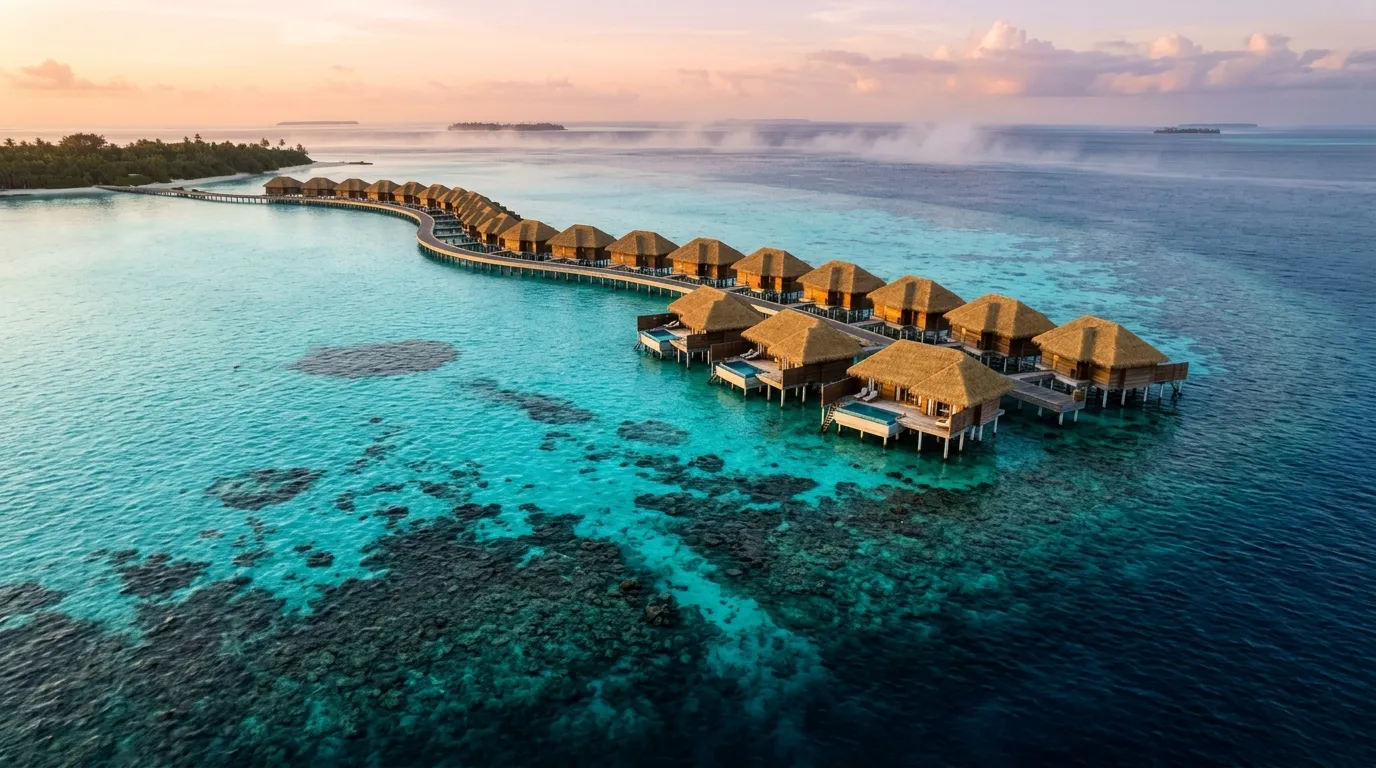
 HubSpot
 Mailchimp
 Zapier
 Meta Ads
 Google Ads